Our Known Unknowns: Germany’s Future Citizens from Ukraine
Ukrainians are now the second-largest migrant group in Germany, and many of them intend to settle here. But beyond ‘hard’ data like employment statistics, what do we know about them and why is it important to get a fuller picture?
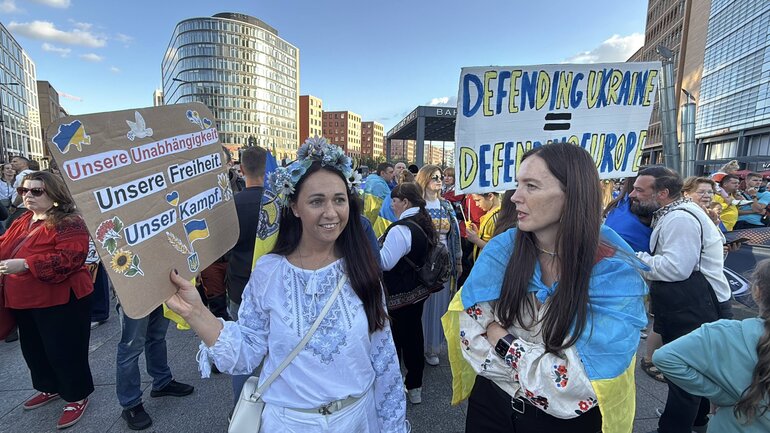
In spring 2027, many of the first Ukrainians who arrived in Germany under the temporary protection scheme introduced after Russia’s full-scale invasion of Ukraine will be eligible to apply for German citizenship. German law allows naturalisation for financially independent residents who have lived here for five years and fulfil certain other criteria. The employment rate of Ukrainians in Germany has risen steadily over time, and the latest data indicate that 37.3 per cent of them are employed in positions subject to social security contributions. Recent legislative reforms in Berlin and Kyiv allowing dual citizenship are likely to make naturalisation a more attractive proposition.
Yet beyond the issue of who will apply for citizenship, with the possible possible end of the temporary protection scheme looming in 2027 or 2028, the question of whether to stay or return is becoming more pressing for Ukrainians in Germany. Surveys of this population by the German Institute for Employment Research (IAB) show that the majority wants to stay long-term.[1] Thus many Ukrainians are here to stay and they will become more engaged in German society and politics over time. Yet who are they?
The blind spot in our knowledge about Ukrainians
The truth is that we know little about their attitudes and values. As in other countries with large numbers of Ukrainian war refugees – such as Poland or the Czech Republic – in Germany, studies of these populations often concentrate on their socioeconomic condition, reflecting a broader tendency of refugee studies to focus on policy-relevant questions and knowledge with a practical use. Thus aspects related to demographics, the jobs market, learning the local language, or housing were covered by multiple waves of IAB surveys in Germany, while issues like sexuality and the family have been studied elsewhere. Other articles examined negative attitudes towards or serious risks to Ukrainian war refugees or their relatively preferential treatment compared to refugees from other regions. However, at the time of writing this article, there have been next to no studies asking the question: What, in social and political terms, do these people believe in and value?
Likely political leanings of German-Ukrainian citizens
Even if only half of the over 1.3 million Ukrainians under the temporary protection scheme in Germany become naturalised in the coming years, the country can expect around 650 000 potential new voters.
How would these new citizens vote if they do turn out for German elections? In the context of the ongoing war, Ukrainians abroad are not likely to be endeared to a party like the AfD that expresses pro-Russian foreign policy sympathies.[2] Yet some indicators suggest that certain Ukrainian voters could be receptive to right-wing messaging. Homophobia remains widespread back in Ukraine even though overall acceptance of the LGBQT+ community has risen significantly since Russia’s full-scale invasion. And a majority of Ukrainians at home oppose the liberalisation of ‘entry and employment’ for citizens of African or Southeast Asian countries, hinting at underlying xenophobia in Ukrainian society.
That said, one of the few studies of attitudes among Ukrainian war refugees in Austria suggests that views Ukrainians once held in the home country do not remain static in the host country.The same study finds that while Ukrainians in Austria are likely to be strongly supportive of the European Union, on gender issues they are more liberal than Ukrainians in Ukraine yet more conservative than the average Austrian.
Social issues obscured by a ‘practicability bias’
Beyond electoral mathematics and values, however, other unexplored issues remain. While studies of Syrian refugees in Germany have addressed social aspects – how they participate in sports, music-making, and volunteer work; how they use mobile media devices; and how they are being politically socialised and develop political interests – similar research on Ukrainian war refugees in Germany remains, to date, scarce. This points to a strong ‘practicability bias’ in studies of displaced Ukrainians, which, in their focus on the practical needs arising from their displacement, often lose sight of these people as individuals.
The discrepancy in the kind of research carried out on Ukrainians and other migrant groups may also result from a belief that Ukrainians are only in Germany on a temporary basis, a view reflected in the German government’s recent (and subsequently reversed) decision to stop funding certain integration courses for new arrivals and plans to withdraw Ukrainians from common social protection schemes, shifting them to the significantly more restrictive asylum support. Another factor could be at play here: the tendency of migration scholars in Europe to focus on the experiences of non-European migrants.
The significant gaps in our knowledge about Ukrainians in Germany are particularly surprising, given that, as of 2025, they constituted the second-largest group of foreigners in Germany. It would seem prudent for the German research and policy communities to take a greater interest in the social and political integration of the Ukrainians who have arrived in Germany since 2022, many of whom are likely to become German citizens. Further research on that community should, moreover, be driven by the need for knowledge that is not strictly policy-oriented but still vital.
[1] By contrast, a survey by the Ukrainian NGO OPORA found that only 20 per cent of Ukrainians in Germany are willing to stay. This difference could be explained by the reluctance of many respondents to admit in a Ukrainian survey that they do not intend to return to Ukraine.
[2] A recent study by the Konrad Adenauer Stiftung found that among Poles in Germany and German citizens with a Polish background (polled together) the AfD enjoys a high level of support (33 per cent). Thus an anti-Russian foreign policy stance does not necessarily mean that certain population groups won’t be drawn to a far-right, pro-Russian party like the AfD outside of their own country.
Kostiantyn Fedorenko is a social scientist at ZOiS with a background in political science. He completed his PhD at the Berlin Graduate School of Social Sciences (BGSS) at Humboldt University of Berlin in 2025 and is currently a post-doc in the Volkswagen Foundation-funded project ‘The “Good”, the “Bad”, and the (Un)democratic: Regulating Civil Society in Democracies under Change’.