When Do Protest Waves Shape Politics in the Balkans?
Public protests have long been a driver of political change in the Balkans. A new dataset and visualisation dashboard allow us to compare protest waves in 10 Balkan countries and identify reasons for their different outcomes.

From Serbia’s student uprising to Albania’s Flamingo Revolution, the Balkans have recently witnessed renewed waves of mass protest. Yet the trajectories of the countries affected differ considerably. In Serbia, a student-led movement that emerged after a canopy collapsed at Novi Sad railway station in November 2024 took nearly two years to translate its mass mobilisation into electoral representation. In Bulgaria, mass demonstrations against a proposed budget and corruption triggered the government’s resignation within just three weeks, followed by an electoral victory for the president’s political party. And in Albania, protests against a controversial infrastructure project have continued, with political consequences that are still unfolding.
These contrasting outcomes raise a central question: Why do some protest waves translate into political change within weeks, while others take years, and some remain ongoing?
Reflecting a longer-term pattern that I have conceptualised as ‘protest democracy’, mass mobilisation is often used as a channel of political contestation alongside electoral participation. Over the past four decades, protests addressing corruption, government accountability, public goods, and labour rights have become a recurring feature of political life in the Balkans, at times reshaping party systems and creating opportunities for new political forces.
A new dataset reveals four patterns that shed light on the historical development, political demands, organisational structures, and outcomes of protest waves in the Balkans.
From individual events to protest waves
Research on social movements and resistance is often organised around individual countries, movements, or episodes of mobilisation. Studying protest waves offers a broader perspective. The Protest Waves in the Balkans dataset brings together 84 protest waves across ten countries that share experiences of state socialism and post-socialist transformation: Albania, Bosnia and Herzegovina, Bulgaria, Croatia, Kosovo, Montenegro, North Macedonia, Romania, Serbia, and Slovenia. Covering the period from 1981 to 2026, the dataset captures 54 variables that document the characteristics and trajectories of each protest wave.
The dataset is also accompanied by an interactive visualisation dashboard created by Iaroslav Boretkskii (ZOiS, KonKoop), which allows users to explore historical patterns, compare protest waves across countries and examine individual cases. Each case profile provides detailed information on the mobilisation, its characteristics and political outcomes, alongside the sources used in its reconstruction.
Many existing protest datasets record only a few characteristics, such as dates, participant numbers, and immediate mobilisation triggers. Some, such as the Armed Conflict Location and Event Data (ACLED) project and the Carnegie Global Protest Tracker, focus primarily on recent years. Others, for example the Nonviolent and Violent Campaigns and Outcomes (NAVCO) Data Project and the World Protests study, rely heavily on global news reports. By contrast, this new dataset adopts a historically oriented, case-by-case approach.
Protest waves are defined as sequences of interconnected protest actions that articulate common or similar demands and are initiated by institutional or non-institutional organisations. To qualify, mobilisation must also meet a threshold of high intensity, measured relative to the country’s population size; this threshold ranges from 5,000 participants in smaller countries such as Montenegro to 20,000 in Romania. A small number of historically significant cases below this threshold were also included.
Importantly, the dataset also examines the political consequences of protest waves. They range from changes at government level and policy concessions to more gradual shifts, such as changes in public opinion and the creation of opportunities for opposition forces, including the development of movement- and protest-based parties. By bringing these dimensions together, the dataset reveals how the organisational, social, and geographical characteristics of protest waves relate to their political effects.
Four regional patterns
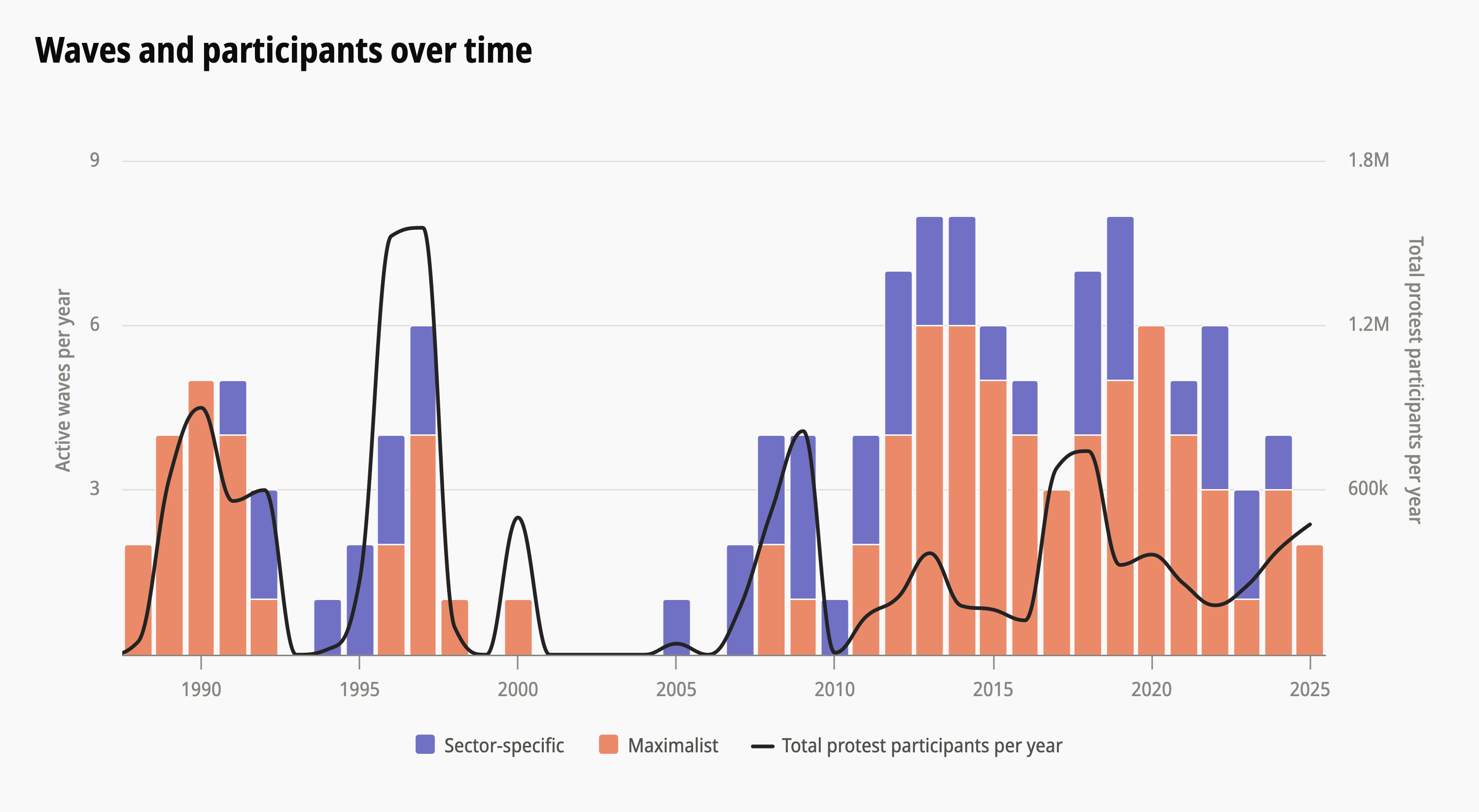
The dataset offers several important lessons. First, protest mobilisation has persisted across different political periods. The distribution of the 84 protest waves reveals four broad phases: the pro-democracy mobilisations that accompanied the turbulent transitions of 1988–2000; the relative decline of the 2000s, when political discontent led to greater electoral competition and the emergence of new political parties; the anti-systemic resurgence of the 2010s, characterised by decentralised movements; and renewed mobilisation in the 2020s, increasingly intertwined with electoral politics (figure 1).
Second, protest demands often extend beyond specific sectoral grievances. In 55 of the 84 cases, protest waves articulated maximalist demands, including regime change and early elections (figure 1). This suggests that mass mobilisation has repeatedly become a vehicle for challenging broader political arrangements, rather than merely seeking concessions on individual policy issues.
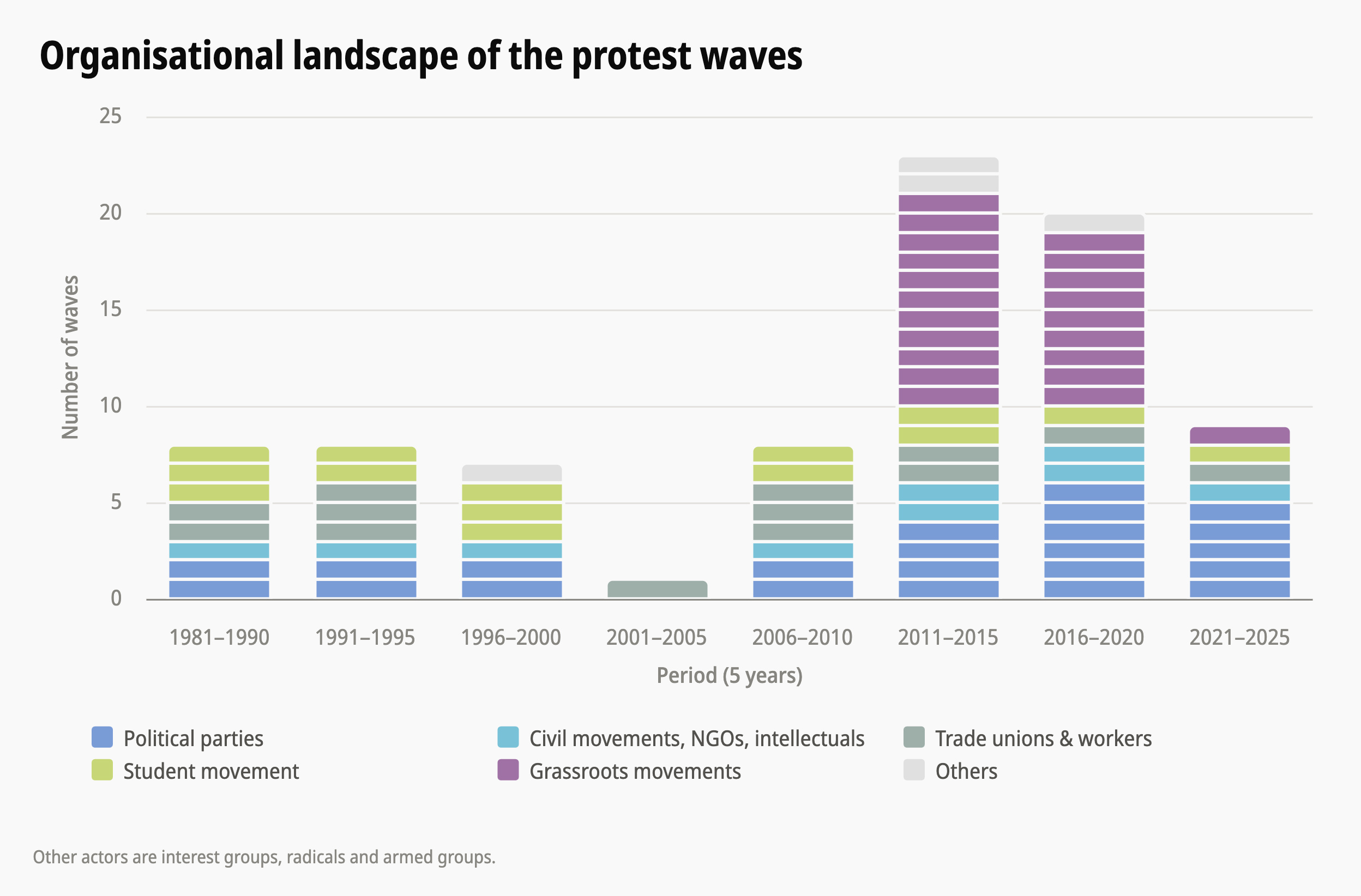
Third, protest waves involve diverse combinations of organisational actors. Civil society organisations, political parties, informal movements, and students all feature prominently (figure 2), with each playing different roles. Especially in the last two decades, informal collectives and self-organised groups have often helped to initiate and sustain mobilisation, while political parties can provide channels for translating protest demands into institutional and electoral politics.
These findings invite further investigation into the relationship between grass-roots organisation and institutional actors.
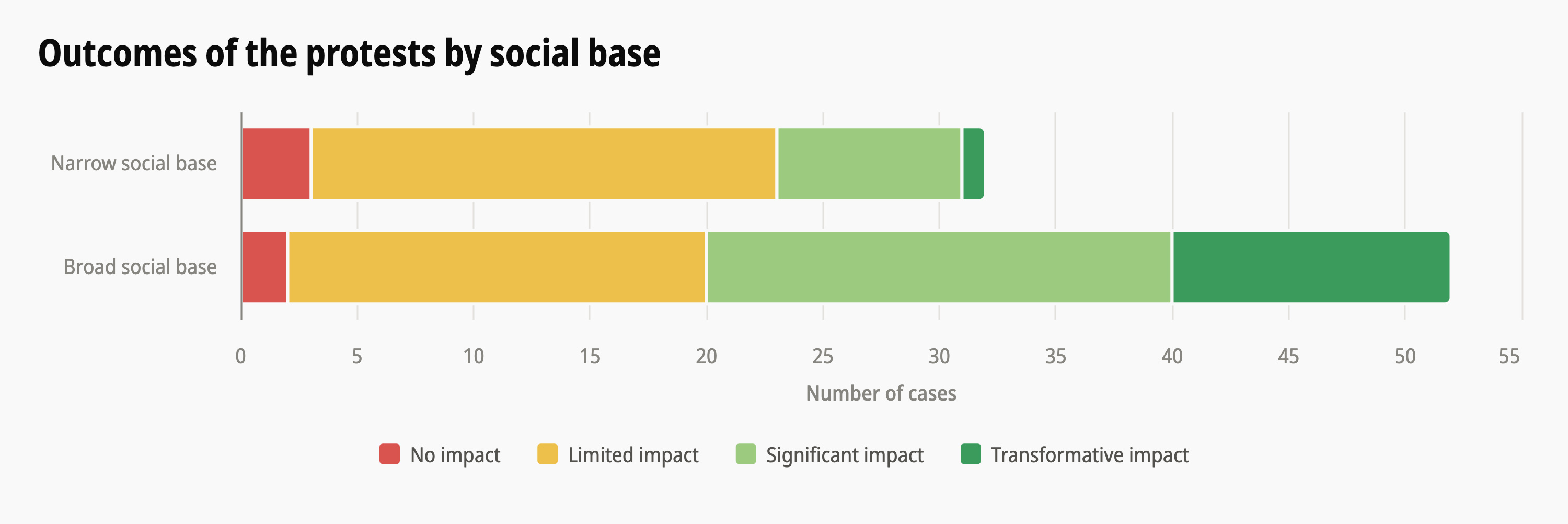
Fourth, the social base and geographical reach of protest waves is linked to their political outcomes. Protest mobilisations are often associated with urban middle-class constituencies. However, the data suggest that protest waves involving a broader social base are more likely to achieve political goals. Among the 52 cases involving a broader social base, including trade unions, blue-collar workers, low-income groups and precariously employed people, 32 (62%) resulted in substantial outcomes. By comparison, only nine of the 32 cases without such a broad social base (28%) had the same level of impact (figure 3). Similarly, nationwide mobilisations were more effective than waves based only in capital cities, suggesting a link between the geographical scale of a mobilisation and its political effects.
These differences raise an important question: does the ability to mobilise across social groups and space increase the likelihood that a protest wave will have a political impact?
A historical perspective on today’s protests
The Protest Waves in the Balkans dataset highlights three interconnected dimensions of contentious politics. Historically, it shows that protest is not an isolated event but a recurring feature of Balkan politics. It also reveals how protest waves emerge through interactions between grass-roots collectives, civil society organisations, students, and political parties, combining formal and informal mobilisation. And it points to the importance of social composition and geographical reach in shaping the consequences of collective action.
By bringing these dimensions together across 84 protest waves, ten countries, and more than four decades, the dataset provides a comparative historical resource for investigating when and under what conditions collective mobilisation translates into political change – and why it sometimes does not. This study invites further research on social movements, contentious politics, and democratisation in Southeast Europe and beyond.
Explore the dataset: https://konkoop.de/pwse/
Dr Ivaylo Dinev is a political scientist and a postdoctoral researcher at ZOiS, where he coordinates the KonKoop research network’s multi-method data laboratory. The project is funded by the German Federal Ministry of Research, Technology and Space.